Description
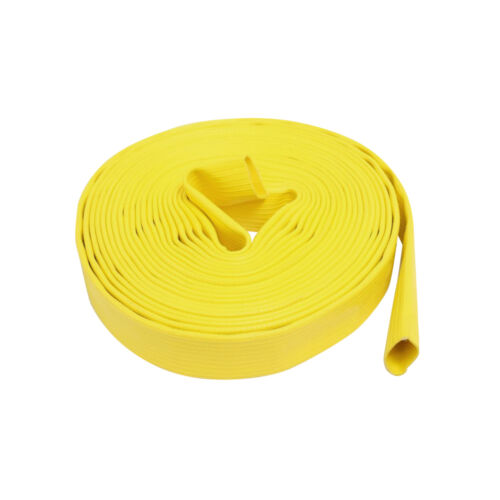
Yellow 6″ X 50′ Coupled Storz Rubber Covered Fire Hose (450 LB Test)
Description
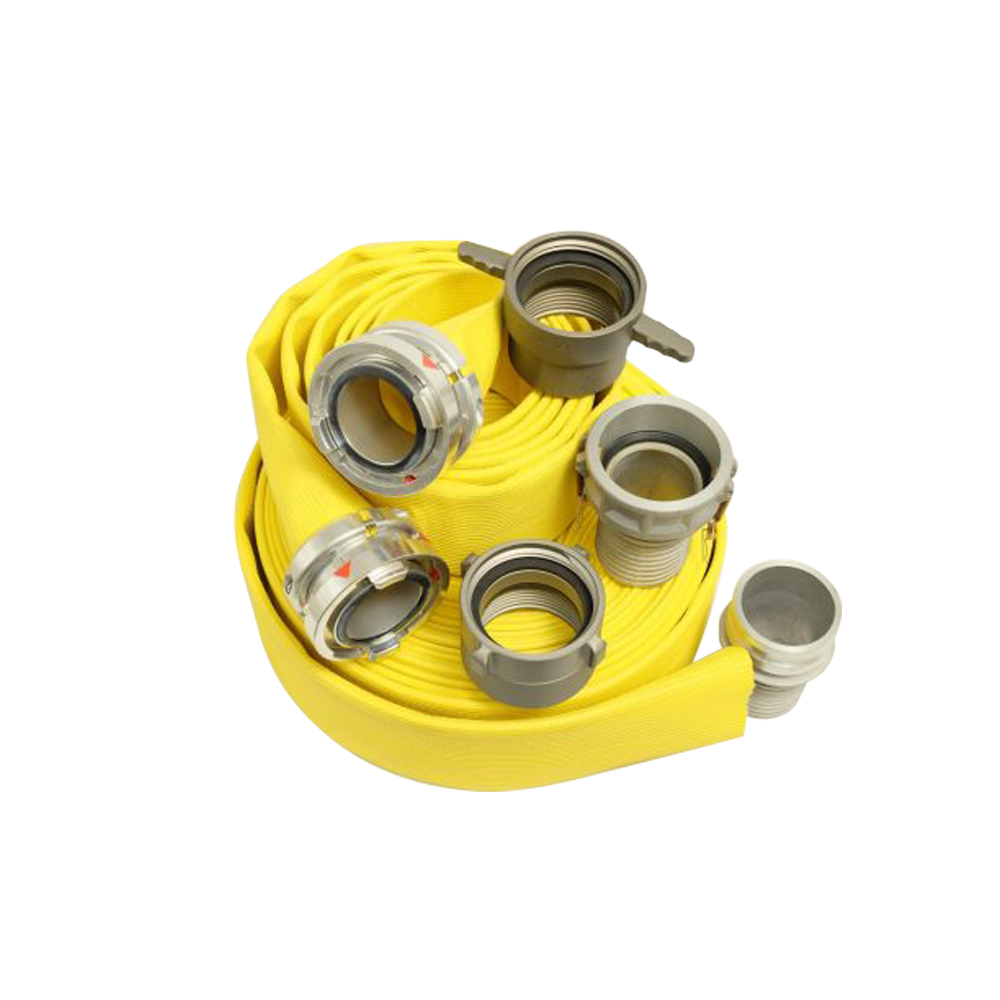
6″ Rubber Covered Fire Hose (450 LB Test)
Today, virtually every fire department uses rubber covered fire hose to move water efficiently. LDH
Hose is flexible hose designed for the purpose of moving water ( or flame
retardant ) between a pressurized water source and a pump that is supplying
attack lines. It may also be used to relay water from one pumper to another over
a long distance. Fire hose is generally considered to be LDH Hose when its
interior diameter exceeds 3½ inches; fire and departments in the United States
typically use LDH with diameters of 4, 5 or 6 inches.
LDH Hose is big-flow, low-pressure hose, which is both its defining feature and
the reason for its popularity. Because friction loss in fire hose is entirely
dependent upon flow, not pressure, the more capacity (GPM) a hose can carry,
the less force (PSI) is needed for the delivery.
This accounts for the ability of LDH to deliver greater water volume, over greater
distances, with less friction loss than smaller diameter hose. With this capability
on their engines, firefighters are able to deliver big water to the fire scene with
• LDH Hose is generally longer than smaller diameter hose. Standard
lengths are typically 100 feet. Short lengths or pony lengths are used for
hydrant hook-ups to charge pumper units.
• LDH Hose is rugged, but not indestructible. Manufacturing techniques
include the extrusion of nitrile rubber in a Thru-The-Weave process or it
may be manufactured by laminating the nitrile rubber cover and liner. In
either case the entire length of the hose is seamless.
• LDH Hose is heavier than smaller diameter hose.
• LDH Hose plus water is very heavy. It is an accepted fire service
understanding that 5-inch LDH will hold 1 gallon of water per foot of hose.
With water weighing 8.33 pounds per gallon, a 100-foot section of 5-inch
LDH filled with water will weigh approximately 944 pounds.
Hose connections are hard-coated / anodized aluminum.
Although threaded connections are typical, the Storz, quick-action coupling
has gained in popularity.




Reviews
There are no reviews yet.